Thursday, November 06, 2014

Broken government comes from a broken electorate

Volunteers at a Democratic field office in DeKalb County, Georgia, use Obama campaign methods to reach out to targeted voters. (PBG/Prose and Thorn)
The finger pointing over who was to blame for Tuesday's devastating losses started as soon as the polls closed - maybe even before in places like Colorado and Kentucky, where flawed campaigns and unforced errors by candidates killed off an incumbent and skewered a rising star.

But Democrats and political analysts all realize that, for the most part, it wasn't the candidates. It wasn't the message. It wasn't the low approval numbers for President Obama in states that could have been in play, or the billions spent by outside groups to link Democratic candidates to him and the majority leader. It was the voters - those who chose to show up and those who stayed home. 

"So, to everyone who voted, I want you to know that I hear you," President Obama acknowledged at a post-election briefing, Wednesday afternoon, adding, "To the two-thirds of voters who chose not to participate in the process yesterday, I hear you, too." 

As Politico rightly points out, the president's choice of words indicate he doesn't see the Republicans' big night as any kind of mandate from the people, since it's only a third that chose to have their voices heard. A lopsided third, but a third nonetheless.

Read the post

Thursday, October 23, 2014

Nunn’s strength: caring community through corporate involvement

Nunn

In his earlier defense of Michelle Nunn over accusations that Points of Light "gave money to terrorists" while she led the organization, Neil Bush went on to praise Nunn for demonstrating “the right kind of visionary leadership – a non-partisan or bipartisan approach to our service world.”

It is precisely that approach to serving the public at all levels that makes her such an appealing candidate, and why she has been leading in the most recent three polls, albeit within the margin-of-error. Her work demonstrates she is authentically engaged in making the world a better place for everyone, rich or poor, Republican or Democrat. Read the post

Monday, October 20, 2014

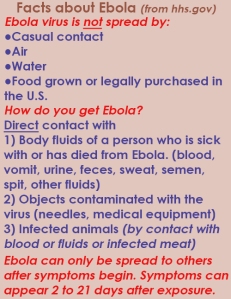
Ebola: Has 'America lost its mind?'

From hhs.gov

Fear is not the appropriate response, but it is very American, in the sense that nothing happening in the world seems to matter until it happens to us. This is a classic American pitfall, where we reach for a mask of ugly paranoia because of our own self importance.

University of Chicago's Harold Pollack says that given the facts about the disease, and the infinitesimally small rate of infection in the United States, we should be more concerned about how alarmist our media is making the situation. "If you’re just tuning in," he added, "you might believe that America has lost its mind."

The phrase "abundance of caution" has been prevalent in stories about Ebola. People vomit on airplanes all the time, but now, we lock them in bathrooms. We close schools and bridal stores for a disease that is not communicable except through direct contact with bodily fluids. That's not "caution;" it's rationalized paranoia.

Read the post

Tuesday, September 02, 2014

Holder's Texas Two Step: voter ID challenge begins

U.S. Attorney General Eric Holder (adapted from British Foreign and Commonwealth Office Flickr photo) and Texas Gov. Rick Perry (adapted from photo by Jonathan Mallard)
U.S. Attorney General Eric Holder (adapted from British Foreign and Commonwealth Office Flickr photo)
and Texas Gov. Rick Perry (adapted from photo by Jonathan Mallard)


It's a battle on two fronts, necessitated by the Supreme Court's decision, last year, to nullify the pre-clearance formula sections of the Voting Rights Act, in Shelby County v. Holder. That left Texas Attorney General Greg Abbott free to pursue what is alleged to be targeted, minority voter disenfranchisement.

On Tuesday, the United States Department of Justice joins other plaintiffs, including Texas voters and candidates, in Veasey v. Perry, challenging the Lone Star State's quick-trigger, post-Shelby resumption of its previously struck voter ID law. Later this fall, DoJ will participate in another round of Perez v. Perry, the case which alleges the state's 2011 redistricting plan is discriminatory, giving Texas' rising Latino minority less representation in government than they are actually due.

A verdict for the plaintiffs in either case could allow Justice to place Texas back on the pre-clearance list for ten years, a "bail in" under Section 3 of the VRA, since, the DoJ maintains, it would demonstrate a persistent pattern of minority voter discrimination. It is their only recourse, since Congress won't act on a new pre-clearance formula.

READ THE ENTIRE ARTICLE>>>