Monday, May 07, 2012

Upcoming Congress the devil in the details this November

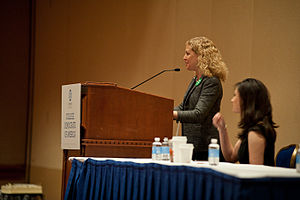
DNC Chair Rep. Debbie Wasserman Schultz speaks...
DNC Chair Rep. Debbie Wasserman Schultz speaks to College Democrats (Photo credit: Wikipedia)
If you've ever heard Rep. Debbie Wasserman Schultz (D-FL) speak of her life in politics, chances are you've heard her story about how the Florida Democratic establishment tried to discourage her from running for the state legislature in 1992. They had someone else in mind, she says, to replace her boss, Peter Deutsch, who was running for the U.S. House, and they wanted her to wait her turn. But, her story goes, she began knocking on doors, visiting families in her South Florida district, and through hard work and determination, became the Democratic nominee in a six-way primary, garnering over 50% of the votes.

Now, as the Chair of the Democratic National Committee, she is not only responsible for talking up the accomplishments of President Obama and his administration, she is also focused on returning Democrats to a majority in the House of Representatives, and securing a filibuster-proof majority in the Senate. While the presidential race is under the bright lights, it is the Congressional race that will determine just how effective a returning Barack Obama will be in his second term. It will be up to Wasserman Schultz, then, to instill her particular brand of political tenacity into the campaigns of her party's incumbents, and into the races where Democrats are challenging GOP incumbents.

In a recent article about the fundraising challenges those running against incumbents face, the Wall Street Journal reports that even though the president's party only needs "a net gain of 25 seats to regain control of the House...many political forecasters say Republicans are likely to retain their majority."

There are eighty House seats the experts consider to be in play this November, the WSJ says, meaning that even though we will vote for the entire 113th Congress, four out of five of them are in districts that are supposedly safe, because redistricting did not harm their chances for retention by whichever party is there now. Since most state houses are run by Republicans, most 2010 GOP districts remain in their hands.

Still, the Democratic Congressional Campaign Committee (DCCC) is on the offensive. It has chosen 63 seats that it thinks it can change from "Red to Blue," only eight of which they classify as "Majority Makers," meaning they are "in strong Democratic districts." Former Rep. Alan Grayson, the outspoken, progressive Democrat, who was ousted in 2010 by Rep. Dan Webster (R-FL) for example, is considered to be in a great position to take the redrawn Florida 9th seat.

Besides retaking Democratic districts which are either open or currently represented by Republicans, the DCCC has identified twenty "Emerging Races," which it describes as "becoming increasingly competitive." Several of those, including the Ohio 7th, currently represented by Rep. Steve Austria (R-OH), benefit the Democrats because of redistricting, and a well run campaign by challenger Joyce Healy-Abrams.

The goal of most on the left, though, remains to unseat as many of the Tea Party freshmen from 2010 as they can. "The American people have rejected this 18-month tea party Republican experiment in Congress as a failure — after they chose millionaires and billionaires ahead of seniors and the middle class," DCCC press secretary, Jesse Ferguson, told Politico, in April.

But, according to a recent New York Times story, by Jennifer Steinhauer, the group swept into office in that election are "eager to prove that they are more than flukes who rode in on a wave only to paddle back out to the sea of one-termers."

Still, "it is one thing to run as an outsider taking aim at Washington dysfunction," Steinhauer goes on to point out, but "when you are the incumbent, with Congressional license plates and a voting record for all to see, it is a whole new ballgame."

Indeed, recent revelations by Bloomberg show that the same candidates who railed against the TARP bank bailouts during their campaigns in 2010, have received donations from Wall Street PACs:
"The political action committees of [JPMorgan Chase & Co., Bank of America Corp., Citigroup Inc., Wells Fargo & Co. and Goldman Sachs Group Inc.] have distributed $169,499 through March 31 to the campaign coffers of the 10 freshman Tea Party-backed lawmakers on the House Financial Services Committee, according to an analysis of campaign finance disclosure records."
Whether or not the plate is set for the DCCC to take back the House is debatable. But if Chairwoman Wasserman Schultz cannot goad her candidates into the kind of political commitment it takes to win an election,  then the predictions of the experts, who say the Democrats will fall short in 2012, will certainly be validated.

If they're wrong, though, and Democrats regain complete control of Congress, will the leadership be more concerned with maintaining control than helping President Obama follow through on some of his bolder initiatives? One of the reasons they lost so resoundingly in 2010 was because they were afraid to take the steps necessary to implement tax policy (like letting the Bush tax cuts expire for the wealthiest Americans), to raise the debt limit without the GOP drama of last year, and to come up with the Dodd-Frank benchmarks, thinking too much about protecting individual legislators than the constituency they represent.

If the Dems are successful, I hope they take a long look at the leadership, in both Houses, and let them know that the surest way to reelection in 2014 is to do what the people sent them there to do - the people's business, which (almost) never converges with Congress' yen for self enrichment, regardless of who's in charge.

-PBG

Friday, May 04, 2012

The Machiavellian vs the Proletariat - whose economy is it, anyway?

"You sit around here and you spin your little webs and you think the whole world revolves around you and your money. Well, it doesn't, Mr. Potter. In the whole, vast configuration of things, I'd say you were nothing but a scurvy little spider!" - George Bailey, from the 1946 film, "It's a Wonderful Life"
In this crazy capitalist, consumer-driven economy of ours, you can be the populist hero George Bailey or the manipulative banker, Mr. Potter. Mitt Romney and his surrogates, want to remind you, though, that even George Bailey was a money lender. His Building and Loan went broke because Potter called in the note, and there was no money when the people came for it.

In 2008, according to Mitt Romney's friend and colleague at Bain Capital, Edward Conrad, it was the investors who panicked and caused a run on the banks, wanting their return when the short term investments didn't pay off. "The banks did what we wanted them to do," Conrad said in a recent interview with New York Times writer, Adam Davidson. "They put short-term money back into the economy. What they didn’t expect is that depositors would withdraw their money, because they hadn’t withdrawn their money en masse since 1929."

According to Conrad, the system was working. Davidson writes:
"[Conrad] argues that collateralized-debt obligations, credit-default swaps, mortgage-backed securities and other (now deemed toxic) financial products were fundamentally sound. They were new tools that served a market need for the world’s most sophisticated investors, who bought them in droves. And they didn’t cause the panic anyway, he says; the withdrawals did."
You see, to Edward Conrad, we are just poor, dullard consumers who don't get the value of the "investor class" (aka the 1%) to our economy. "Most citizens are consumers, not investors," he told Davidson. "They don’t recognize the benefits to consumers that come from investment."

Davidson interviewed Conrad in advance of the publication of his book, “Unintended Consequences: Why Everything You’ve Been Told About the Economy Is Wrong.” Davidson characterizes the pro-bank, pro-wealth disparity scree with the anti-blurb, "This could be the most hated book of the year."

Conrad ignores the many other factors that played a role in investors wanting their money back. Manufacturing has been leaving this country in droves since 1970s, and according to PolitiFact, no president lost more manufacturing jobs than George W. Bush - over 430 million per year he was in the Oval Office. Yet Bush insisted that Freddie Mac and Fannie Mae work with conventional lenders and community groups, "such as the National Urban League, the National Council of La Raza, ACORN(!) and others," to get people into "a home of their own," even if they couldn't afford it, as a stepping stone to the "American Dream."

More homes being bought meant more loans. More loans meant more money for banks. Eventually, they started bundling the loans together in units and selling those. When the investors Conrad says made a run on the banks for their money, it was partly because the siphoning off of manufacturing jobs caused consumers to lose confidence, and real small businesses (not small corporations that wore the moniker for the funding) began to lay off people. Notes couldn't be met, homes were lost through default, and as the defaults increased, those who held the notes began to panic. So it was a loss of jobs, and the resulting loss of consumer capital, that caused the economy to collapse.

Conrad has proposed what could be called the anti-Dodd-Frank legislative step of "creating a new government program that guarantees to bail out the banks if they ever face another run," Davidson says. Does Conrad's pal, Romney, really think that the public wants banks to receive guaranteed bailouts every time there's a colossal financial system fuck up? How would they sell that to the Tea Party folks, who hate the Bush bank bailouts?

Davidson's interview with Conrad reveals that people like him see people as either the innovative, risk-taking investment class, or as "art history majors," who seem unwilling to put forth the effort to succeed. He claims that there should be more people like him, and they should be making double the money they do now, disparity be damned. To him, it seems, you're either in a yacht, or your treading water. Tread harder, because a rising tide may lift all the boats, but unless you innovate a floatation device, you'll drown, which Conrad would probably say, in the whole vast configuration of things, is your own fault.
Hancock-Bain bldg
John Hancock Tower, Boston, MA,
home of Bain Capital
(from RhythmicQuietude, through Creative Commons)
-PBG

Sunday, April 22, 2012

The effluence of influence

"On the mornings that had once throbbed with the dawn chorus of robins, catbirds, doves, jays, wrens, and scores of other bird voices there was now no sound; only silence lay over the fields and woods and marsh." - Rachel Carson, in her seminal book about the unchecked use of pesticides in post-war America , Silent Spring
Rachel Carson, in 1962, published a book that moved a nation to do something about the devastating environmental impact of DDT. Setting the stage for her argument, she wrote of a hypothetical morning in a not too distant future, where nature will have been stymied into silence by the overuse of insecticide that made its way through the food chain, killing birds, plants and bees. As a result of Ms. Carson's well documented work, laws were passed outlawing the civilian use of DDT, and awareness was raised about just what kind of impact our lifestyle has on the planet we share with the rest of nature. People stood up. Something got done.
This spring, it's time to pay attention to a perhaps more insidious pollutant that affects the way we live. Winter's acrid snowfall of presidential election idiocy has distracted us, muffling the voices of protesters that began screaming last fall about fair access to the ears and hearts of our lawmakers, that didn't involve entering through their wallets. Despite President Obama renewing the call for "fair play, shared responsibility," in the spring thaw, there is only the creaking of Congress' rusty wheels blowing across the election year breeze. It's the practiced deafness of a seized machine - not the gear churning, consensus building, bill producing process with which our legislative branch is tasked.
"Some insecticides affect sensitive plants ... retarding root development or depressing growth of seedlings." - Rachel Carson, ibid
Plants can't grow properly in soil infected by toxins, and our Congressional ecosystem has been toxified by money. The laws that come out of Congress have long had their potential stunted by the ugly politics of greed and corporate congressional corruption. We are promised fields of green, spring wheat and acres of blooming flowers, and are presented with AstroTurf and plastic poppies. This isn't what government should look like. This is a painted backdrop of mythical American glory, an artifice created by the corporate manipulators and political strategists, where they can stage a bought Congress that passes the laws they write with the help of ALEC.

Money to congress like DDT on crops(DDT dusting photo by USDA)
For most members of Congress, it seems that Capitol Hill is just another market where power is the commodity and there are plenty of big-monied lobbyists looking to buy. Sure, America is a free market economy, but let's keep the free market in the marketplace, and not in the halls of Congress, where lobbyists and Super PACs line the walls, trading laws for dollars like the moneychangers at the Temple gates. A den of thieves, to be sure.
The first five words of the First Amendment are, "Congress shall make no law." Unfortunately, it seems, Congress has stopped right there, taking the phrase out of context as easily as a super PAC ad, and using it to illustrate their attachment to the meme that government can't do anything. What's really sad is everyone knows they can't do anything. In the recent arguments before the U.S. Supreme Court, about the Affordable Care Act, there was an acquiescence to the stymied way the 112th Congress has limped through its tenure.
In one exchange, on the third day of oral arguments, regarding what might happen to the entire law if the so-called individual mandate were struck down, Justices Sotomayor and Scalia had this telling indictment of the current Congressional process in an exchange with Paul Clement, who was arguing that the law should be scrapped. Justice Sotomayor asks Clement (page 7, line 10), "I guess, on the bottom line, is why don't we let Congress fix it?"
"Well, let me answer the bottom line question," Clement responds, "if you strike down the mandate, there's going to be something for Congress to do. The question is really what task do you want to give Congress? Do you want to give Congress the task of fixing the statute after something has been taken out, especially a provision at the heart, or do you want to give Congress the task of fixing health care?"
"[W]hatever you do," Clement later adds, "Congress is going to have options."
It's there that Scalia interrupts the petitioner, with the most practical question of the entire proceeding: "Well, there's such a thing as legislative inertia, isn't there?"
"[W]e all recognize there's legislative inertia," Clement goes on to agree, "And then the question is what's the best result in light of that reality?"
The Supreme Court of the United States has little respect for Congress' ability to get anything done, and they're right to think that. Those attending the proceeding found the whole notion of Congress buckling down to "fix" the healthcare law laughable:
(page 26, line 14)
MR. CLEMENT: At a certain point, I just think that, you know, the better answer might be to say, we've struck the heart of this Act, let's just give Congress a clean slate. If it's so easy to have that other big volume get reenacted, they can do it in a couple of days, it won't be a big deal. If it's not, because it's very -
(Laughter.)
MR. CLEMENT: -- well, but -- I mean, you can laugh at me if you want, but the point is, I rather suspect that it won't be easy.
No, Mr. Clement. It won't be easy, because nothing in Congress is easy. They need 60 votes to get anything done in the Senate, and the House is passing budget bills with the goal of "sharpening the contrast," as Rep. Paul Ryan (R-WI) put it, between the majority party and the president during an election year. It's all done for political points and serves only the perpetual campaigners in Congress, not the American people.
While it may be easy to blame Congress, though, this is our fault too. They lead not just by our votes, but also by our example. If we are silent about our polluted and corrosive system, then they will be too. If we are unwilling to allow our elected representatives to be a cacophony of "sound and fury, signifying nothing," then we have to make certain we don't represent the same thing to them. Meaning, if we want them to actually get in there and do the work of enacting laws that help everyone in this country prosper, then we have to be willing to do the same. We appear to have given up on our federal government being functional, and so have they. There's not much left for them to do except rake in the cash from defanged regulations. If they saw us giving the issues that affect our fellow citizens the due diligence they deserve, perhaps they would too.
I don't know what SCOTUS is going to do about severing the individual mandate from the Affordable Care Act, but just as Scalia argued against presenting Congress with a "false choice" of all, some or none of the act intact, we have a similar choice when it comes to Congress in November - do we re-elect all, some or none of them? Maybe we can just sever the toxic ones. Then, perhaps, the seeds a new Congress plants will have a chance to prosper, for all of us.
"No witchcraft, no enemy action had silenced the rebirth of new life in this stricken world. The people had done it themselves." - Rachel Carson, ibid
-PBG

Saturday, March 24, 2012

Looking Under the Hoodie

The exposure is stark, high contrast, black and white. The last time this country cared even near this much about a person in a hoodie was that infamous sketch of the sunglassed Unibomber, Ted Kaczynski. But wearing a hoodie doesn't make one evil, threatening or a gangster, despite FOX News showman Geraldo Rivera's bizarre assertion that, "His hoodie killed Trayvon Martin as surely as George Zimmerman did."
Blaming Trayvon Martin for being suspicious in a hoodie is like blaming a rape victim because she wore something sexy. Judging someone because of what they wear or the way they talk is the same prejudice that judges them by their skin color. Sure, there are times when "appropriate" attire is required, like a funeral or a job interview, but the kid was just walking on a particular street, like hundreds of other kids do, everyday. Apparently, some people don't want kids to be kids, especially if they are Black (or Asian or Hispanic or Muslim).
 American Minds
The lesson here is less about the gun lobby's "Stand Your Ground" law, than it is about how far we still have to go to recognize all Americans, regardless of race, color or creed, as neighbors first, and criminals only when there's direct evidence from that individual to support specific suspicions.
We are meaning making machines, a teacher once told me. We relate to other people (and our environment) with the lessons past experience has taught us, or, lacking direct experience, we draw conclusions based on "stories" we have heard from our prime influences - our parents and our community. So all it takes to change the reflexive responses to social situations to which we resign ourselves, is a willingness to acknowledge that things may not be what you were always led to believe they were.
That's not always an easy thing to do. It requires disavowing some deeply held beliefs, letting go of our grip on the familiar bar that has gotten us this far in life, and like a trapeze artist, trusting that there's another mindset that will catch you and validate your new feelings. If you've ever had to admit you were wrong about something, in just about any context, you've done something similar. The biggest difference is admitting something you once thought was correct is flawed, compared to something you were certain about could be wrong.
Here's an exercise from the Book of Oversimplification that may help you. Let's say you have this idea that you look terrible in stripes. Try wearing stripes on a date, or to an important meeting, and see if it really matters. Better yet, try listening to your significant other in a conversation, while you're wearing stripes, and pretend you don't automatically know where they're coming from. Be willing to be surprised, by every one and everything. Americans are better than the racial profiling that passes for vigilance these days. George Zimmerman may not be there yet, but you can be. Give it a try.
 -PBG